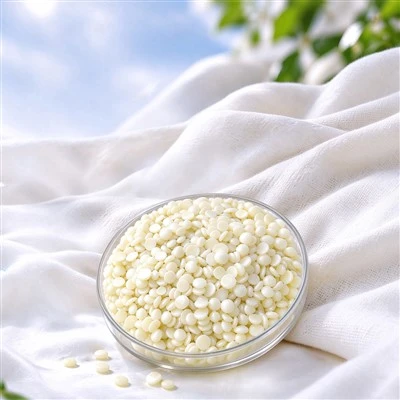
In the textile processing chain, while pretreatment agents do not directly influence the final product's appearance, they play a crucial role in "reshaping the texture and clearing pathways" for fabrics. Their application spans the entire dyeing and finishing pretreatment process, affecting not only the release of fiber processability but also the efficiency, energy consumption, and environmental performance of subsequent processes. They are the core medium connecting raw material characteristics and final product quality.
The primary use is to remove inherent fiber barriers and activate processing potential. Natural fibers (such as cotton and linen) contain byproducts such as sizing agents, pectin, and waxes, while synthetic fibers (such as polyester and nylon) are covered with spinning oils and oligomers. These impurities hinder the uniform penetration of dyes and auxiliaries, leading to problems such as uneven dyeing and printing bleeding. Pretreatment agents, through desizing, scouring, and refining, directionally decompose or emulsify these impurities: amylase preparations precisely cleave the glycosidic bonds of starch sizing agents, and surfactant complex systems simultaneously strip away waxes and oils, restoring the fiber surface to cleanliness and a porous structure, establishing uniform pathways for subsequent dyeing.
Secondly, pretreatment agents play a crucial role in regulating fiber surface properties and optimizing process compatibility. Different fibers exhibit significant differences in hydrophilicity and hydrophobicity, and blended fabrics, due to their complex composition, are prone to "localized dye rejection" or "excessive absorption." Pretreatment agents can regulate fiber surface charge and wettability by introducing specific functional groups (such as sulfonic acid groups and polyoxyethylene chains): when performing alkali reduction pretreatment on hydrophobic polyester, specialized agents can reduce the rate of damage to the fiber by strong alkalis, simultaneously improving its hygroscopicity and dye affinity; for cotton/spandex blends, pretreatment agents can inhibit the swelling and deformation of spandex, ensuring that both fibers complete impurity removal simultaneously, avoiding fabric wrinkling or loss of elasticity due to uneven shrinkage.
A deeper application lies in supporting green production and reducing costs and increasing efficiency. Traditional pretreatment relies on strong alkalis and strong oxidants, which not only generates high-COD wastewater but also requires large amounts of hot water rinsing. Novel pretreatment agents, through the application of bio-enzyme catalysis and low-foaming surfactants, can remove impurities at room or low temperatures, reducing water, electricity, and steam consumption. Their easily removable molecular design (such as the ability to hydrolyze ester bonds) reduces reagent residue, shortens the number of washes, and directly reduces wastewater treatment pressure and overall costs.
From "obstacle removal" to "empowerment," from "quality assurance" to "driving low-carbon development," the applications of textile pretreatment agents have transcended the scope of simple chemical treatment, becoming a crucial pillar for the textile industry's transformation towards high quality and sustainability.