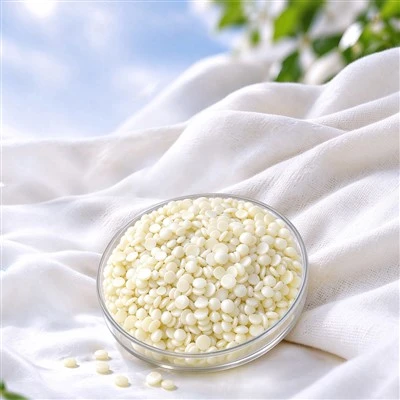
Product Overview
Weak cationic softeners are specialized finishing agents formulated for cellulose, synthetic, and blended textile substrates. Engineered with a controlled, low positive charge density, these products adsorb onto negatively charged fiber surfaces via electrostatic interaction while preventing the heavy shade alteration and thermal yellowing characteristic of conventional strong cationic softeners. Supplied as pourable white emulsions with active contents ranging from 25% to 40%, they integrate directly into existing exhaust or padding finishing lines.
-
![Weak Cationic Softener for Cotton]() Weak Cationic Softener for CottonHonesoft® QS-1026view more
●Weak Cationic Softener for Cotton delivers a soft and smooth hand feel.
●Good stability against salt and alkali.
●Low yellowing.
●Good anti-phenolic... -
![Weak Cationic Fluffy Softener]() Weak Cationic Fluffy SoftenerHonesoft® QS-CSNview more
●Weak Cationic Fluffy Softener delivers a soft and fluffy hand feel.
●Good stability against salt and alkali.
●Good anti-phenolic yellowing... -
![Weak Cationic Fluffy Softener for Hoodie and Cotton]() Weak Cationic Fluffy Softener for Hoodie and CottonHonesoft® QS-939view more
●Weak Cationic Fluffy Softener for Hoodie and Cotton is suitable for hand feel finishing of heavy fabrics such as hoodies.
●Very fluffy and soft hand feel... -
![Weak Cationic Yarn and Leather Softener]() Weak Cationic Yarn and Leather SoftenerHonesoft® QS-938view more
●Weak Cationic Yarn and Leather Softener can be used as both a yarn smoothing agent and a leather softener.
●Good salt-resistant, alkali-resistant and anion-resistant...


Key Features
Low Yellowing Profile:
Maintains original shade and whiteness metrics on optical-brightened or pastel-dyed cotton and polyester blends after high-temperature stenter processing (150--180°C).
Electrolytic Stability:
Withstands hard water up to 150 ppm CaCO3, Glauber's salt, and common acetic acid buffer solutions without phase separation or precipitation.
Shear Stability:
Operates stably under high mechanical turbulence in jet dyeing machines and high-speed padding mangles up to 50°C.
Re-wetting Properties:
Preserves capillary water absorption rates better than standard fatty acid condensates, ensuring treated towels and apparel retain baseline moisture management.
Product Types / Options

Fibers: 100% cotton, viscose, Tencel, polyester, nylon, and poly-cotton blends.
Exhaust Method: Jet dyeing machines, overflow machines, and winches. Recommended dosage: 1--3% o.w.f. (on weight of fabric) at 40--50°C for 20--30 minutes.
Padding Method: Stenter frame lines and two-roll mangles. Recommended dosage: 10--30 g/L with pick-up rate of 70--80%.
Application & Process Considerations
Bath pH Control:
Maintain liquor pH between 4.5 and 5.5 using acetic acid to optimize chemical adsorption and prevent precipitation.
Sequencing:
Add the softener as the final component in the finishing bath after dyestuffs, fixing agents, and crosslinkers are fully dispersed. Avoid direct contact with anionic surfactants.
Drying Parameters:
Fix at 120--130°C drying temperature followed by curing at 150--170°C for 30--60 seconds. Excessive temperatures above 180°C may induce slight thermomigration on specific disperse dye shades.
Manufacturing & Quality Control
Synthesis Process: Batch-controlled emulsification utilizing high-shear rotor-stator homogenizers to achieve a stable particle size distribution below 150 nm, reducing the risk of oil spotting on dark-shade fabrics.
Quality Testing Protocol: Every production lot undergoes mandatory lab testing for active content (via evaporation residue), pH, viscosity (Brookfield RVT, spindle 3, 20 rpm), and centrifugal stability (3000 rpm for 15 minutes).
Compliance Standards: Manufactured in accordance with ISO 9001 quality management systems. Formulations comply with REACH Annex XVII regulations, ZDHC Level 3 MRSL conformance requirements, and OEKO-TEX Standard 100 restricted substance lists.
Container Options: 120 kg / 200 kg high-density polyethylene (HDPE) drums and 1000 kg Intermediate Bulk Containers (IBC).
Storage Stability: Store in original sealed containers between 5°C and 35°C in a well-ventilated warehouse. Protect from freezing and direct sunlight. Shelf life is 12 months.

FAQ
As one of the leading weak cationic softener manufacturers and suppliers in China, we offer a wide range of products with superior quality for industrial. Please rest assured to buy bulk weak cationic softener made in China here from our factory. Contact us for more details.
Cotton fluffy high whiteness pearl softener, Weak Cationic Softener for Cotton, Cotton soft low color change pearl softener